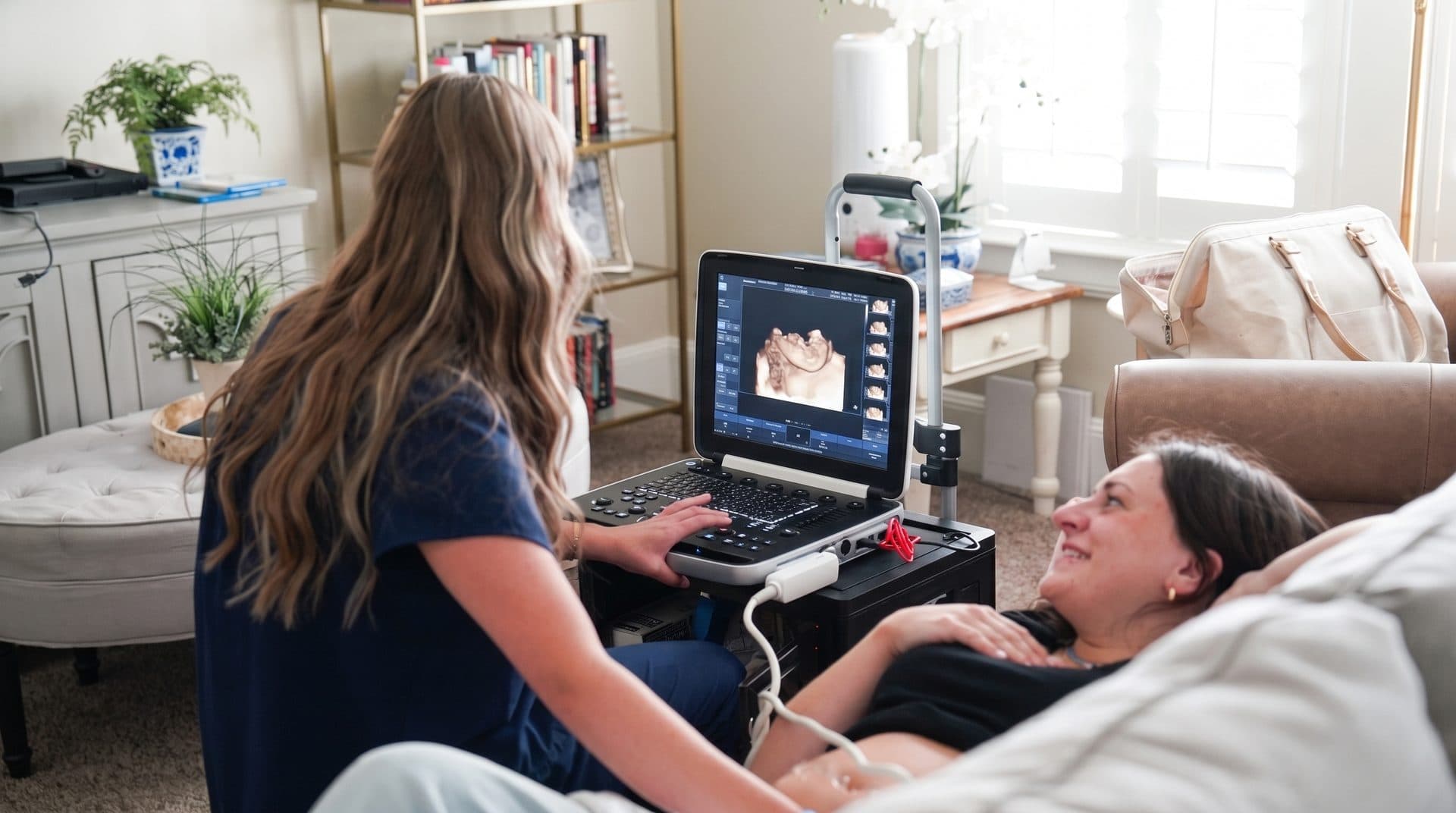
When researching ultrasound options during pregnancy, you've likely encountered terms like "3D ultrasound" and "4D ultrasound." While they sound similar, there are important differences between these technologies. This guide breaks down everything you need to know about 3D vs 4D ultrasound, helping you decide which option is right for your pregnancy journey.
What is 3D Ultrasound?
3D ultrasound creates three-dimensional still images of your baby. Unlike traditional 2D ultrasound that shows flat, black-and-white cross-sections, 3D ultrasound captures thousands of images from different angles and combines them to create a lifelike, dimensional image. What you can see with 3D ultrasound: Detailed facial features including nose, lips, and cheeks. Clear views of fingers, toes, and other body parts. Surface detail of your baby's skin. Realistic, photograph-like images that are easy for non-medical professionals to interpret. 3D ultrasound is particularly valuable for bonding with your baby before birth, as the images look remarkably like newborn photos.
What is 4D Ultrasound?
4D ultrasound is essentially 3D ultrasound in motion - the fourth dimension being time. Instead of still images, 4D ultrasound creates a live video stream, allowing you to watch your baby move in real-time with the same three-dimensional detail. What you can see with 4D ultrasound: Everything visible in 3D ultrasound, but moving. Real-time movements like yawning, stretching, and smiling. Baby sucking their thumb or playing with the umbilical cord. Facial expressions as they happen. Breathing movements and swallowing. The video element of 4D ultrasound adds an incredible dynamic quality that many parents find deeply emotional and memorable.
3D vs 4D Ultrasound: Key Differences
Here's a side-by-side comparison to help you understand the main differences:
Image Type
3D Ultrasound: Still photographs, similar to a regular photo album. 4D Ultrasound: Live video recording, like watching a movie of your baby.
What You See
3D Ultrasound: Detailed snapshot of baby at a moment in time. Clear facial features and body parts. 4D Ultrasound: Continuous movement including yawns, kicks, facial expressions. Real-time activity and behaviors.
Best For
3D Ultrasound: High-quality printed photos for photo albums and sharing. Clear anatomical detail for specific features. Parents who prefer still images. 4D Ultrasound: Capturing baby's personality and movements. Emotional bonding through seeing real-time actions. Parents who want video memories.
Session Length
3D Ultrasound: Generally shorter sessions (20-30 minutes). 4D Ultrasound: Often longer sessions (30-45 minutes) to capture various movements.
Technology Requirements
3D Ultrasound: Requires specialized ultrasound equipment with 3D imaging capability. 4D Ultrasound: Requires advanced equipment capable of processing real-time 3D images at video speed.
Which is Better: 3D or 4D Ultrasound?
The truth is, neither is inherently "better" - they serve different purposes and many parents choose packages that include both. Most modern 3D/4D ultrasound sessions actually include both 3D still images AND 4D video. You don't have to choose one or the other. Consider 3D ultrasound if: You want high-quality still images for printing and framing. You prefer individual photos showing specific features clearly. You want images that are easy to share digitally or print in photo albums. Consider 4D ultrasound if: You want to see your baby's movements and personality. You'd love video footage of baby yawning, moving, or sucking their thumb. You want a more dynamic, emotional bonding experience. Most parents choose: Combined 3D/4D packages that include both still images and video footage, giving you the best of both technologies.
Traditional 2D vs 3D vs 4D Ultrasound
It's also helpful to understand how both 3D and 4D compare to traditional 2D ultrasound:
2D Ultrasound (Traditional)
Purpose: Medical diagnostic tool used throughout pregnancy. What it shows: Flat, black-and-white cross-sectional images. Best for: Measuring baby's growth, checking organ development, medical diagnostics. When used: Multiple times throughout pregnancy for medical monitoring. Image quality: Requires trained medical professional to interpret.
3D Ultrasound
Purpose: Bonding and keepsake imaging (can also be used for certain medical diagnoses). What it shows: Three-dimensional still photos showing surface detail. Best for: Clear facial features, bonding, keepsake photos. When used: Typically once or twice during pregnancy (26-32 weeks ideal). Image quality: Easily recognizable by anyone, photograph-like.
4D Ultrasound
Purpose: Bonding and keepsake videos showing baby in motion. What it shows: Real-time 3D video of baby's movements. Best for: Seeing personality, capturing movements, emotional bonding. When used: Same as 3D, often combined in one session. Image quality: Movie-like video that anyone can understand and enjoy.
What to Expect: 3D/4D Ultrasound Session
Most modern ultrasound providers offer combined 3D/4D sessions that include both technologies. Here's what a typical session includes: Duration: 30-45 minutes of scanning time. What you receive: Multiple high-quality 3D still images (often 20-40+ images). 4D video footage (usually 10-30 minutes of edited video). Digital files via USB drive, online gallery, or both. Printed photos (package-dependent). During the session: Your sonographer will first check baby's position. They'll capture various 3D images of face, hands, feet, and profile. They'll record 4D video of baby's movements. You'll see everything on screen in real-time. Family members can typically join and participate.
3D/4D Ultrasound at Roam Imaging Utah
At Roam Imaging, our 3D/4D ultrasound packages include both technologies - you get beautiful 3D still images AND amazing 4D video footage. We bring our state-of-the-art ultrasound equipment directly to your home anywhere in Salt Lake County, Davis County, or Weber County. Our ARDMS-certified sonographer ensures you get the highest quality 3D images and 4D videos during your session. Every package includes: High-resolution 3D still images. 4D video footage of baby's movements. Digital delivery of all images and videos. The comfort of your own home with all family members present. We serve Salt Lake City, Ogden, Layton, West Jordan, Sandy, Draper, South Jordan, Bountiful, and surrounding areas.
Conclusion
Understanding the difference between 3D and 4D ultrasound is simple: 3D creates still photographs while 4D adds movement for live video. The good news? You don't have to choose - most modern ultrasound packages include both technologies, giving you beautiful still images to frame and cherish plus amazing video footage of your baby moving and showing their personality. Ready to experience both 3D and 4D ultrasound? Book your mobile 3D/4D ultrasound session with Roam Imaging Utah today. We'll come to your home and capture both stunning photos and memorable videos of your baby.
Frequently Asked Questions
Do I have to choose between 3D and 4D ultrasound?
No! Most modern 3D/4D ultrasound packages include both. You'll receive 3D still images AND 4D video footage during the same session.
Is 4D ultrasound more expensive than 3D?
Since most providers offer combined 3D/4D packages, there's typically not a separate price. At Roam Imaging, all our packages include both 3D images and 4D video at one price.
Which is clearer, 3D or 4D ultrasound?
The image quality is the same - both use the same 3D technology. The difference is that 3D captures still images while 4D shows those images in motion. Individual 3D photos may appear slightly sharper since they're optimized still images rather than video frames.
Can you see gender with 3D or 4D ultrasound?
Yes, gender can be determined with both 3D and 4D ultrasound, typically from around 16 weeks onward. However, standard 2D imaging is often used for initial gender determination, with 3D/4D providing confirmation and better visualization.
When is the best time for 3D/4D ultrasound?
The ideal window for both 3D and 4D ultrasound is 26-32 weeks of pregnancy. This is when babies have developed clear facial features but still have room to move for good positioning.
Ready to Book Your 3D/4D Ultrasound?
Experience the magic of seeing your baby in stunning 3D/4D - in the comfort of your own home. Mobile ultrasound in eligible ZIP codes across Salt Lake, Davis, Weber and Utah counties.
3D/4D Ultrasound Available Throughout Utah
Roam Imaging provides mobile ultrasound services across the Wasatch Front. We come to your home for a private, comfortable experience.
Related Articles
When Can You Get a 3D Ultrasound? Best Weeks
The clearest 3D images come at 26–32 weeks — see what baby looks like week by week, and book an at-home 3D/4D session anywhere in Utah from $185.99.
Private Ultrasound Near Me: Utah Guide
Searching for private ultrasound near me in Utah? Discover how elective prenatal ultrasound works, what to expect, pricing, and why thousands of Utah families choose private 3D/4D imaging.